Parebolas pa' que Entienda
Interaction Design, 2018
Interaction Design, 2018
For a museum-design studio at Universidad de Los Andes in Bogotá, a 10-person multidisciplinary team was tasked with turning academic research into a physical exhibition in one semester. Our subject was colombianismos, the everyday Colombian words that are spoken constantly but rarely noticed, and that standard Spanish-language dictionaries leave out entirely.
The challenge was translating linguistics research, dictionary archives, and interviews with linguists into an exhibition that felt playful and interactive rather than academic, within a fixed budget and a hard deadline of opening day, December 11, 2017.
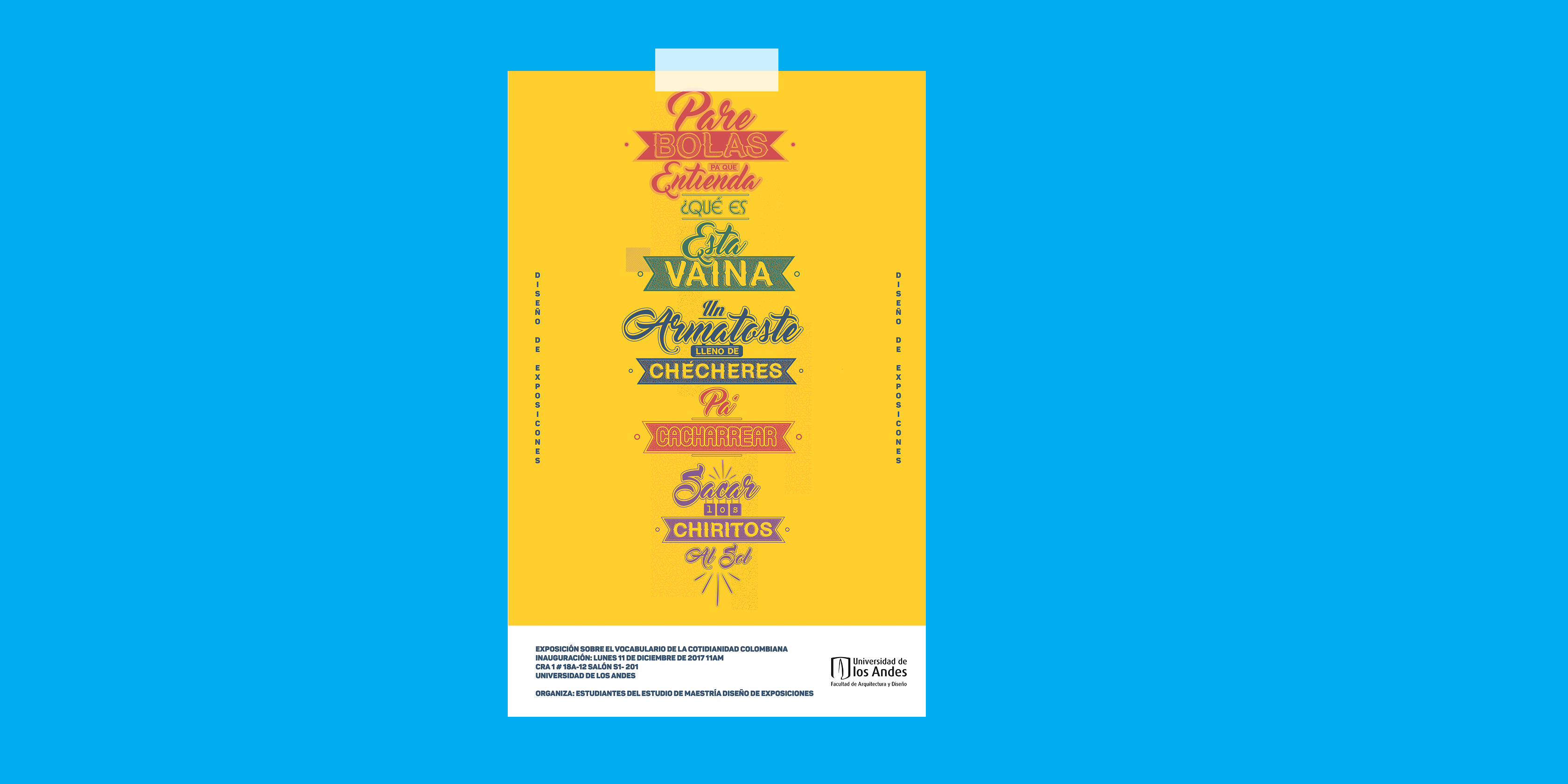
We designed and built "Pare Bolas Pa' que Entienda," a full exhibition space organized into four color-coded stations, each dedicated to a stage in the life of a word, from birth and regional variation to everyday use and reinvention. Visitors moved through analog and digital interactions, including a rotating "word obituary," a slang translator, and a hand-cranked dictionary machine holding 400 words, before reaching a library, a shop, and a live dictionary that grew with each visitor's own contributions.
I led graphic design and communication for the project, covering the visual identity, the curatorial and wayfinding graphics, and the print and social materials that introduced visitors to the space. The identity paired serif type (a nod to printed dictionaries) with a playful custom typeface against a palette of Colombian primary colors, plus green and purple to mark each station, and furniture combined minimalist wood construction with the colorful plastic crates found in everyday Colombian markets and homes.
The finished exhibition packed 4 stations, 10 distinct visitor interactions, and a working dictionary of 286 Colombian words into one room, opening on schedule to the public at Universidad de Los Andes. This was an academic studio project rather than a commercial launch, so there's no attendance or engagement data to report. The measurable win was shipping a fully built, fully interactive exhibition, on budget and on deadline, as a 10-person team spanning architecture, industrial design, systems engineering, and design.